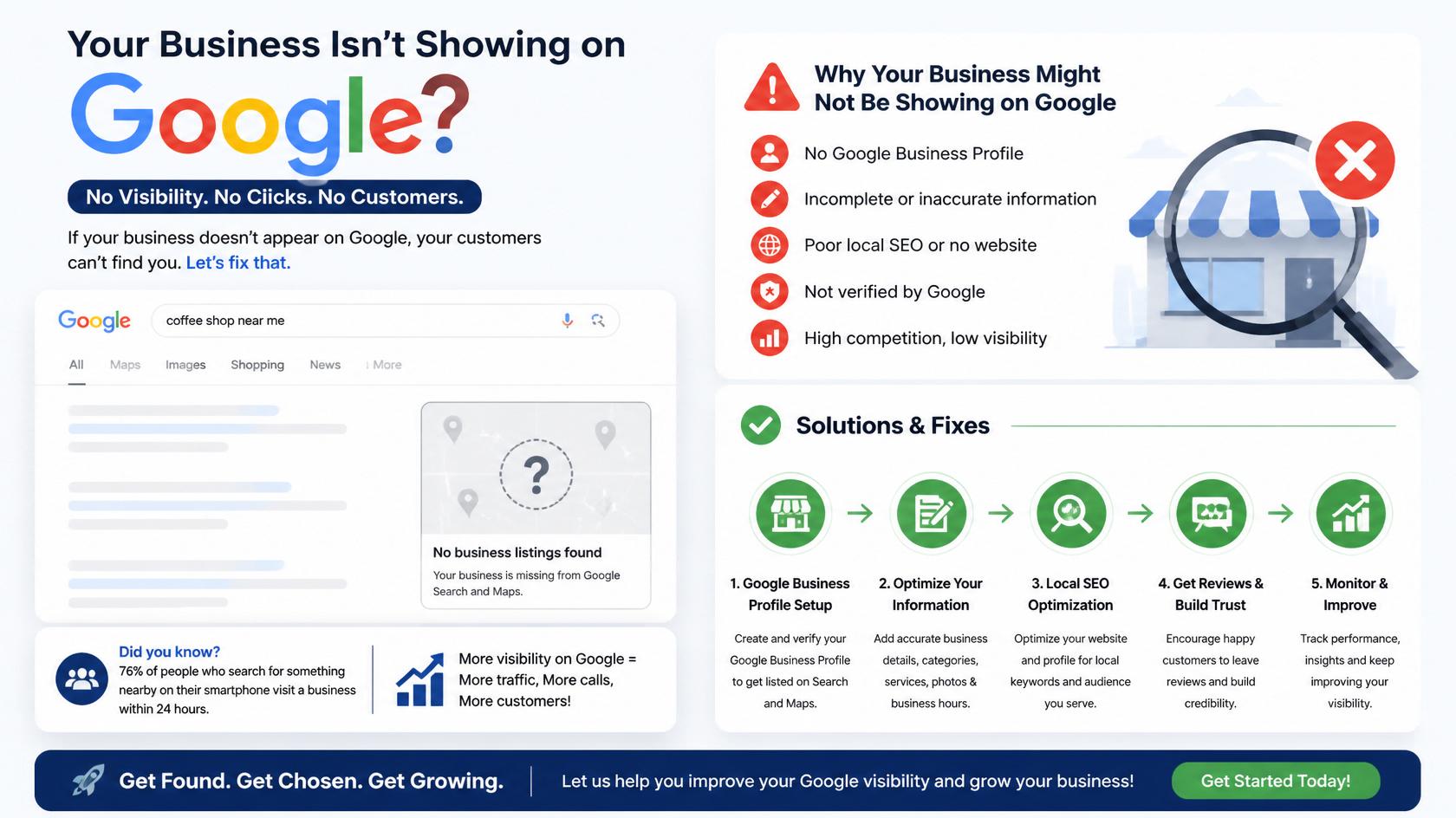
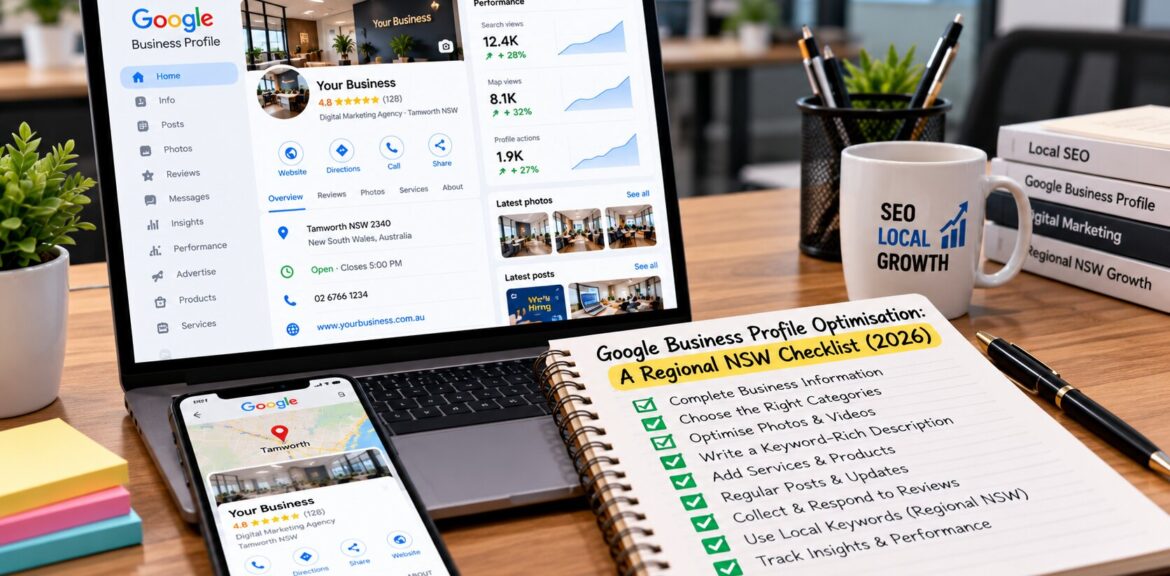

Ask a regional business owner what their Google Business Profile does and you’ll often hear “it’s just the listing with my phone number on it”. That undersells it badly. For most local searches, your profile is the first thing a customer sees, and often the only thing. They read your rating, glance at your hours, tap the call button, and never open your website at all.
This checklist walks through what actually moves a profile up the map results in 2026, what’s within your control, and what isn’t. It’s written for regional NSW businesses, where the customer might be searching from a farm gate outside Dubbo, a car park in Coffs Harbour, or a phone at the Wagga Wagga saleyards.
First, what does Google say it’s ranking on?
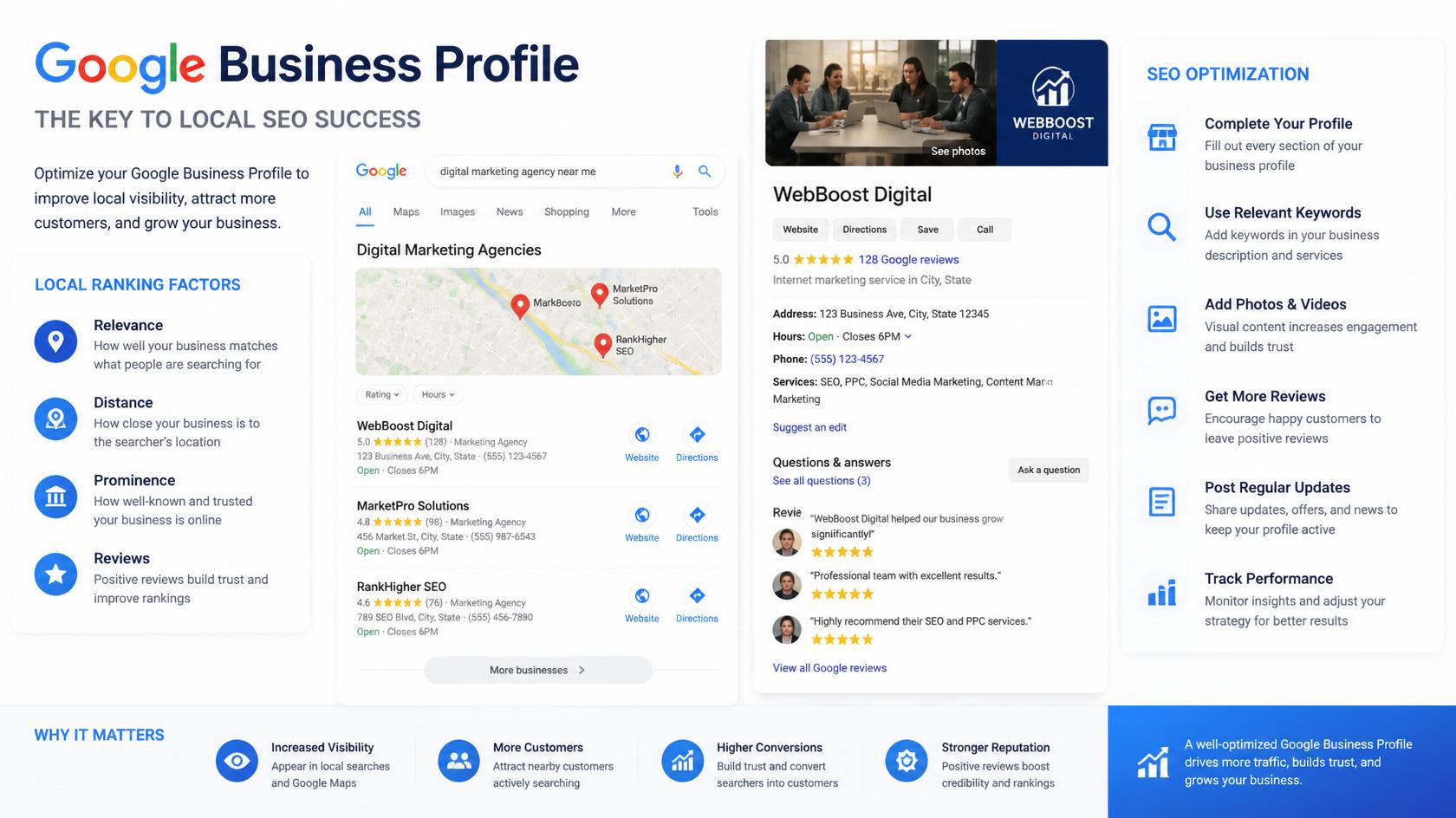
Google’s own help documentation keeps it simple. Local results are based mainly on three things: relevance (how well your profile matches the search), distance (how far you are from the searcher) and prominence (how well-known you are, which draws on reviews, links and general web presence).
You can’t change distance. If someone searches from the other side of town, a competitor around the corner has an edge you can’t buy. What you can do is get relevance and prominence right, which is where the checklist below comes in.
For a more granular view, the Whitespark Local Search Ranking Factors survey is the industry’s most-cited benchmark. The 2026 edition, published in November 2025, asked 47 local SEO specialists to score 187 factors. It’s an expert opinion survey, not Google’s own algorithm, but it’s useful for knowing where to spend your effort. In it, the primary business category scored highest for Maps and local pack results, ahead of proximity and keywords in the business name. Business hours (being open at the time of the search) also entered the top ten for the first time.
1. Choose the right primary category (and be specific)
Your primary category tells Google what you are. Everything else supports it.
- Pick the most specific category available. “Electrician” beats “Contractor”. “Dentist” beats “Health”.
- Add secondary categories only for services you genuinely offer as a real part of the business. Don’t add a category because you’d like to rank for it.
- Review your competitors’ categories if you’re unsure. If the top three profiles for your service all use the same primary category and you don’t, that’s a clue.
Categories can change over time as Google refines its list, so it’s worth rechecking yours once or twice a year.
2. Use your real business name
You’ll see the Whitespark data listing “keywords in business title” as a strong factor, and some businesses draw the wrong conclusion: add “Cheap Emergency Plumber Orange” to the name field. Don’t. Google’s guidelines say your profile name should reflect your real-world business name as it appears on your signage, stationery and website. Keyword-stuffed names are one of the most common reasons profiles get suspended or edited by Google, and a suspension costs far more than any ranking gain.
If your registered trading name already contains a relevant service word, that’s fine. Just don’t invent one.
3. Get your address and service area right
This one trips up a lot of regional operators, so it’s worth slowing down.
If customers visit you (a cafe, a clinic, a retail shop), show your address.
If you travel to customers (a plumber, mobile mechanic, landscaper), you’re a service-area business. You can hide your address and list the towns and suburbs you serve instead.
Here’s the trade-off worth knowing: the 2026 Whitespark survey flagged whether an address displays on the profile as a notable factor for local pack rankings. That doesn’t mean a home-based tradie should publish their house address. Google requires you to be accurate, and you may not want customers turning up at your front door. It does mean service-area businesses need to compensate through stronger reviews, better on-site content and tighter relevance signals.
Whichever way you go, make sure the map pin sits exactly where it should. Pin placement is another factor that entered the top ten in 2026.
If you service several towns, our guide on ranking in multiple NSW towns without doorway pages explains how to list service areas on your profile and structure your website to match.
4. Keep your hours accurate, including holidays
“Open at the time of the search” is now one of the strongest local pack factors in the Whitespark survey. In plain terms: a business that’s open can outrank a business that’s closed, even if the closed one is otherwise stronger.
- Set your standard hours and keep them honest.
- Add special hours for Christmas, Easter, Anzac Day and any local show-day or long-weekend closures.
- If you offer after-hours or emergency callouts, say so clearly in the description and on your website, rather than listing 24 hours you don’t really work.
Regional businesses often run flexible hours, so check these every quarter. Wrong hours are also one of the quickest ways to collect a one-star review.
5. Fill in every field that applies
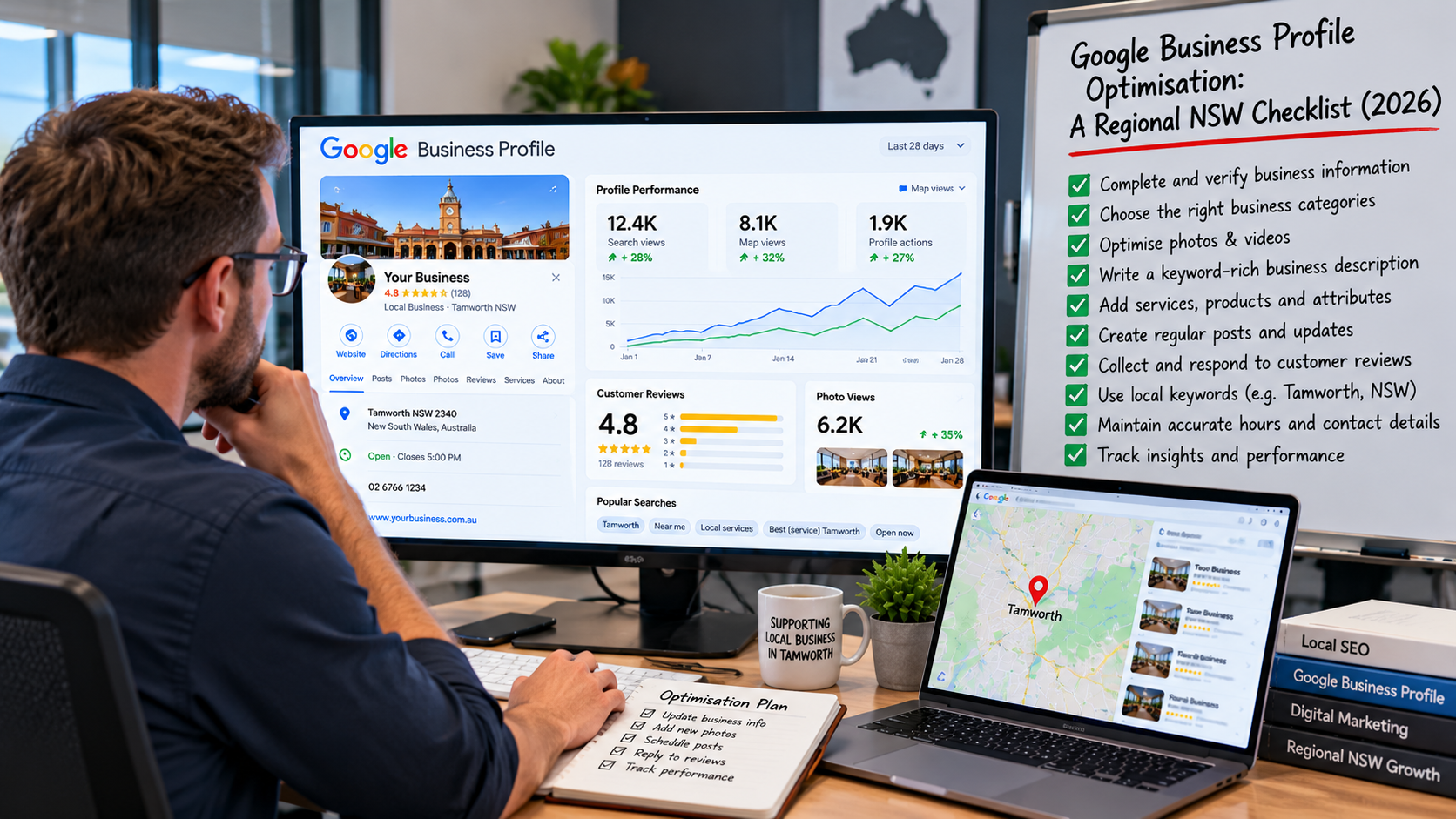
Complete profiles perform better and give customers more reasons to choose you. Work through:
- Services: list each service with a short, plain-English description
- Products (if you sell them) with photos and prices where possible
- Attributes: wheelchair access, online appointments, women-owned and so on, but only if true
- Business description: a clear 750-character summary of what you do, who for and where, written for humans rather than stuffed with suburb names
- Contact and booking links: use your most relevant landing page, not just the homepage
6. Upload real photos, and keep adding them
Customers trust photos of actual people, vehicles, workshops and finished jobs far more than stock images. Aim for a spread: exterior (so people can find you), interior or workspace, your team, your branded vehicle, and recent work.
Name files sensibly before upload and take photos on a decent phone in good light. You don’t need a studio. A fresh set every month or two also tells customers you’re active.
7. Post updates and offers regularly
Profile posts won’t make or break your rankings, but they show customers and Google that the business is alive. Use them for seasonal reminders, new services, completed projects and local events. Keep them short, genuine and tied to what real customers ask about.
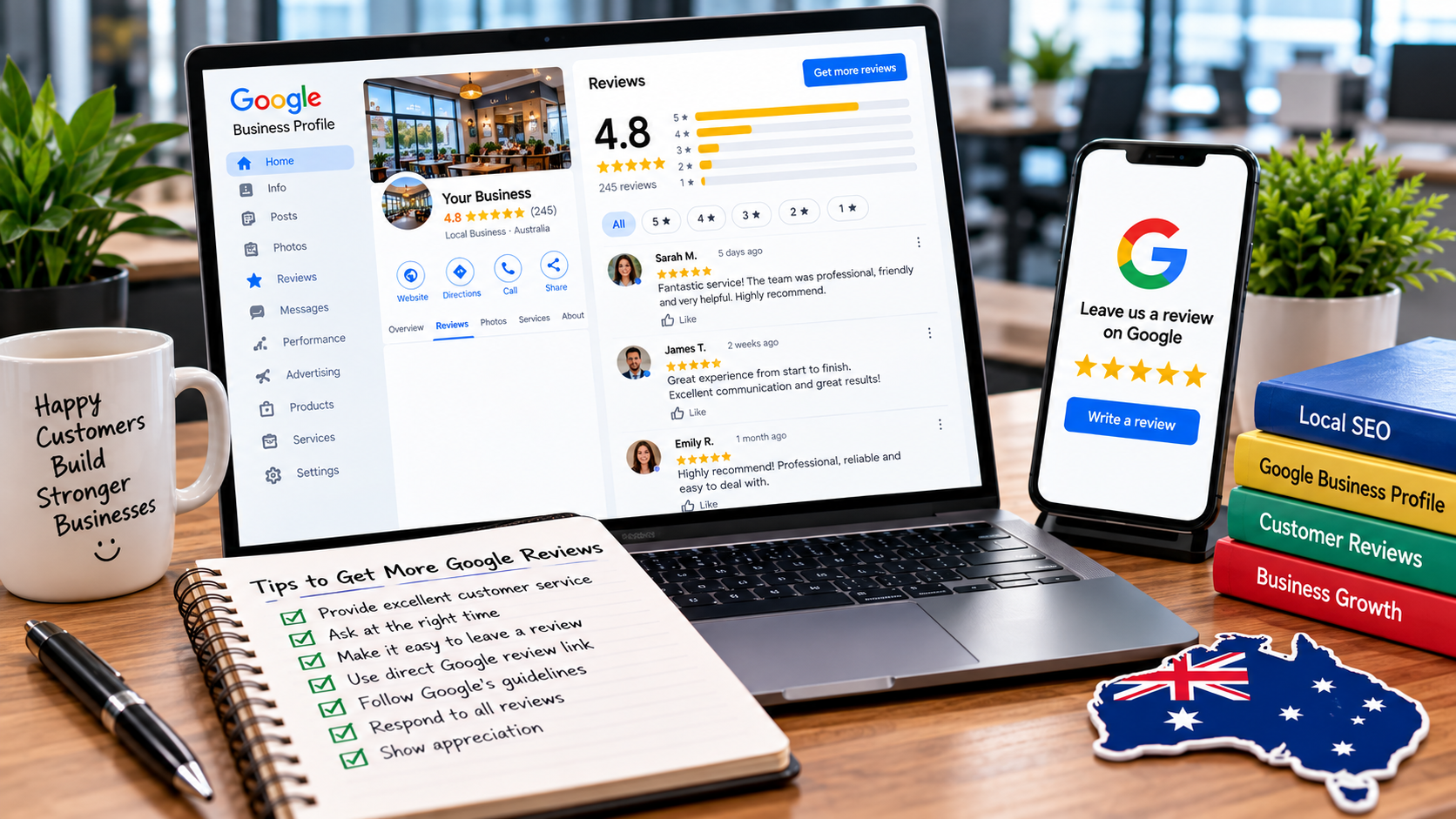
8. Build reviews and respond to every one
Reviews are both a ranking factor and a conversion factor. Whitespark’s 2026 data pointed to Google ratings as a growing influence, and it’s the first thing a customer scans before calling.
- Ask every happy customer, ideally at the moment they’re happiest.
- Respond to every review, good or bad, politely and specifically.
- Never offer cash for reviews, never write your own, and never filter who you ask.
The rules on this are firmer than most owners realise, and breaching them can attract regulator attention as well as profile penalties. We’ve covered it in detail in how to get more Google reviews in Australia without breaking the rules.
9. Make your business details consistent everywhere
Your name, address and phone number (often shortened to NAP) should match across your website, social profiles and the directories customers actually use. Citations carry a smaller share of ranking weight than they did a few years ago, but inconsistent details still confuse both customers and search systems, particularly the AI tools that now pull from multiple sources. Our piece on how regional businesses get recommended by AI search explains why this matters more than ever.
10. Connect your profile to your website
Your website and your profile should tell the same story. Make sure your service pages match your listed services, your location details align, and your key landing pages load fast on mobile. A strong profile pointing to a slow, thin website wastes the click. If your site needs a rebuild, read our website redesign SEO migration checklist before you start so you don’t lose the rankings you’ve already earned.
Common mistakes that cost regional businesses calls
- Keyword-stuffing the business name, which risks suspension
- Using a PO Box or virtual office as your address, which Google may reject
- Setting up duplicate profiles for the same location
- Ignoring reviews, especially negative ones
- Leaving old hours up after a seasonal change
- Listing a service area far larger than you realistically cover
- Never checking Insights to see calls, direction requests and search terms
How we approach it at Organic SEO Guru
Since 2019 we’ve worked with Australian businesses on local visibility, and Google Business Profile work sits at the centre of our local SEO service. That includes category research against real local competitors, profile clean-up, review strategy, citation consistency and tracking calls and direction requests, so you can see what’s driving enquiries rather than just watching rankings.
We run this for businesses across regional NSW, including Newcastle, Wollongong, Port Macquarie and Armidale, and each market gets treated on its own terms. Not sure how your profile stacks up? Start with a free SEO analysis.