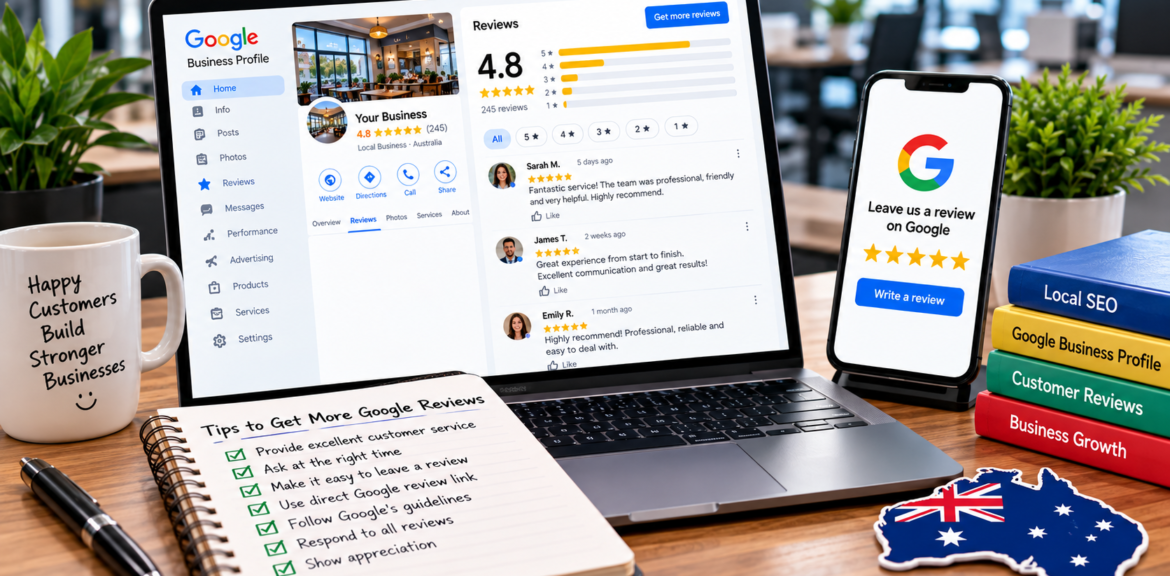

A plumber in a regional town finishes a job, the customer says “that was brilliant, thanks mate”, and they shake hands. Two weeks later a competitor with a 4.8-star rating gets the next call from the same street. The work was equally good. The difference is that one business asked for a review and the other didn’t.
Reviews are one of the few parts of local SEO that customers see directly. They influence whether someone clicks, calls or scrolls past, and they feed into how Google ranks you on the map. But in Australia, how you collect reviews matters almost as much as how many you collect. Get it wrong and you risk Google removing reviews, penalising your profile, or attracting attention from the competition regulator.
This guide covers how to get more reviews the honest way.
Why reviews matter more than ever
Reviews do three jobs at once.
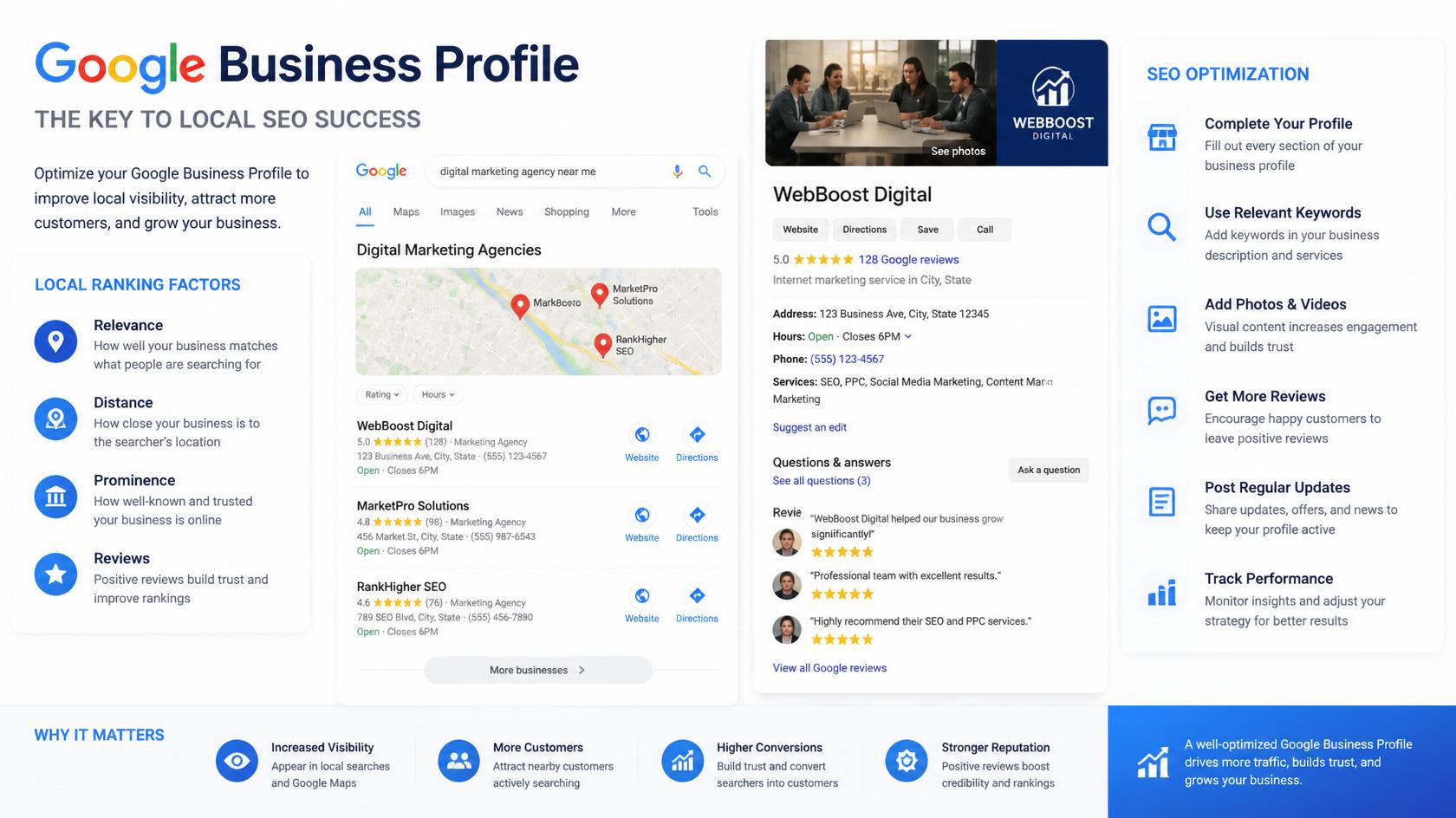
They help you rank. In the Whitespark 2026 Local Search Ranking Factors survey (47 local SEO specialists scoring 187 factors, published November 2025), high Google ratings rose in importance compared with the 2023 edition. It’s an expert survey rather than a statement from Google, but it matches what most local SEOs see in practice.
They help you convert. A customer comparing three profiles will usually pick the one with the stronger rating and more recent feedback, often without visiting a website.
They now feed AI recommendations. BrightLocal’s September 2026 study of 200,000 localised searches across ChatGPT, Google AI Mode and AI Overviews found Google Business Profile accounted for around 28.5% of all citations. A separate 2026 benchmark from SOCi, based on US multi-location brands, found businesses recommended by ChatGPT averaged around 4.3 stars. Those are overseas datasets, so treat the exact numbers cautiously, but the direction is clear: weak ratings make you harder to recommend. We explore this further in our guide to getting recommended by AI search.
The rules you need to know first
What the ACCC says
The Australian Competition and Consumer Commission treats misleading reviews as a breach of the Australian Consumer Law. Its guidance for businesses boils down to a few principles:
- Don’t write, post or commission fake reviews about your own business or a competitor’s.
- Don’t pay or reward people for reviews without clearly disclosing it.
- Don’t hide, edit or remove genuine negative reviews where you control the platform, because omitting negative reviews can be as misleading as posting fake positive ones.
The ACCC’s December 2023 review of 137 businesses found 37% had engaged in concerning review conduct, including unclear disclosure of incentives and manipulation of reviews. The regulator has also taken enforcement action against businesses for posting fake reviews. You can read the regulator’s own material in its online reviews and testimonials report.
What Google prohibits
Google’s policies for reviews prohibit fake engagement, conflicts of interest (like reviewing your own business or your competitors’), and offering incentives for reviews. They also prohibit review gating, which means only asking happy customers for reviews while steering unhappy ones elsewhere. Google can remove reviews or restrict profiles that breach these rules.
A special note for health practitioners
If you work in a regulated health profession, extra rules apply. Under the National Law, advertising can’t use testimonials about clinical aspects of care, and Ahpra advises that if you invite reviews on third-party sites you should ask all patients, not only those likely to be positive, and never reward or pressure them. We’ve covered the details in our guide to SEO for healthcare and allied health practices. Check Ahpra’s advertising hub for current requirements before building a review process.
How to ask for reviews the right way
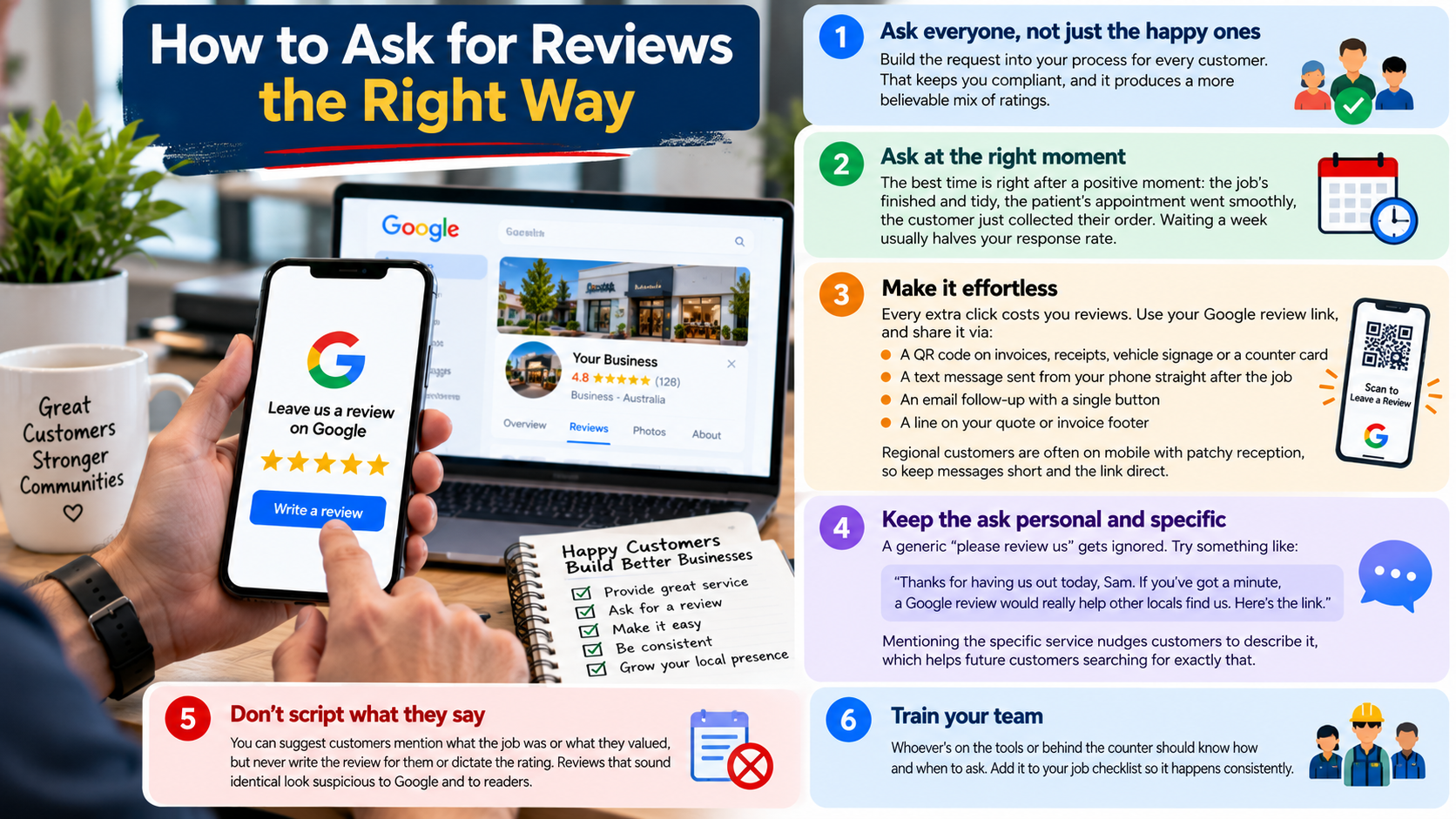
1. Ask everyone, not just the happy ones
Build the request into your process for every customer. That keeps you compliant, and it produces a more believable mix of ratings.
2. Ask at the right moment
The best time is right after a positive moment: the job’s finished and tidy, the patient’s appointment went smoothly, the customer just collected their order. Waiting a week usually halves your response rate.
3. Make it effortless
Every extra click costs you reviews. Use your Google review link, and share it via:
- A QR code on invoices, receipts, vehicle signage or a counter card
- A text message sent from your phone straight after the job
- An email follow-up with a single button
- A line on your quote or invoice footer
Regional customers are often on mobile with patchy reception, so keep messages short and the link direct.
4. Keep the ask personal and specific
A generic “please review us” gets ignored. Try something like:
“Thanks for having us out today, Sam. If you’ve got a minute, a Google review would really help other locals find us. Here’s the link.”
Mentioning the specific service nudges customers to describe it, which helps future customers searching for exactly that.
5. Don’t script what they say
You can suggest customers mention what the job was or what they valued, but never write the review for them or dictate the rating. Reviews that sound identical look suspicious to Google and to readers.
6. Train your team
Whoever’s on the tools or behind the counter should know how and when to ask. Add it to your job checklist so it happens consistently.
What not to do
- Don’t offer discounts, gifts or prize draws for reviews. Incentivised reviews are risky under both Google’s policies and consumer law.
- Don’t buy reviews from third-party sellers. The ACCC examined businesses that sell fake reviews and has been clear they breach the law.
- Don’t gate. Don’t send happy customers to Google and unhappy ones to a private feedback form.
- Don’t review yourself or your competitors, and don’t ask family and staff to.
- Don’t edit reviews that you display on your own website to make them sound better.
Responding to reviews
Replying to reviews shows future customers how you treat people, and Whitespark-style surveys consistently rank response behaviour as a positive signal.
Positive reviews
Keep it short, warm and specific. Thank them by name, reference the job, and avoid copy-paste replies.
“Thanks Dave, glad the hot water system’s sorted before winter. Appreciate you trusting us with it.”
Negative reviews
- Pause before replying. Don’t respond when you’re angry.
- Acknowledge the issue without arguing or getting defensive.
- Take it offline. Offer a phone number or email to resolve it properly.
- Don’t reveal private information, particularly in health or legal contexts.
- Follow up. If you fix the problem, some customers will update their review.
A thoughtful reply to a bad review often does more for your reputation than ten five-star ratings.
Fake or abusive reviews
If a review clearly breaches Google’s policies (it’s from a non-customer, contains abuse or is obviously fake), flag it through your profile and keep evidence. Don’t retaliate publicly. Removal isn’t guaranteed or fast, so keep building genuine reviews to dilute the impact.
How many reviews do you need?
There’s no universal number. A better benchmark is your local competitors. Look at the top three businesses for your main service in your town. If they have 80 reviews averaging 4.8 and you have 12, closing that gap is your priority. Steady, ongoing reviews also look more natural than a sudden burst followed by silence.
Putting it into practice in regional NSW
Reviews carry extra weight in smaller markets, where word of mouth already does a lot of the selling. A customer in Armidale or Orange often knows someone who’s used you, and the Google rating is how they verify what they’ve heard. Our local SEO pages for Orange, Armidale and Coffs Harbour cover how review strategy fits into broader local campaigns.
If you’d like help building a compliant review process, it’s part of our local SEO service. And if you want to understand how reviews fit alongside your profile setup, start with our Google Business Profile checklist.