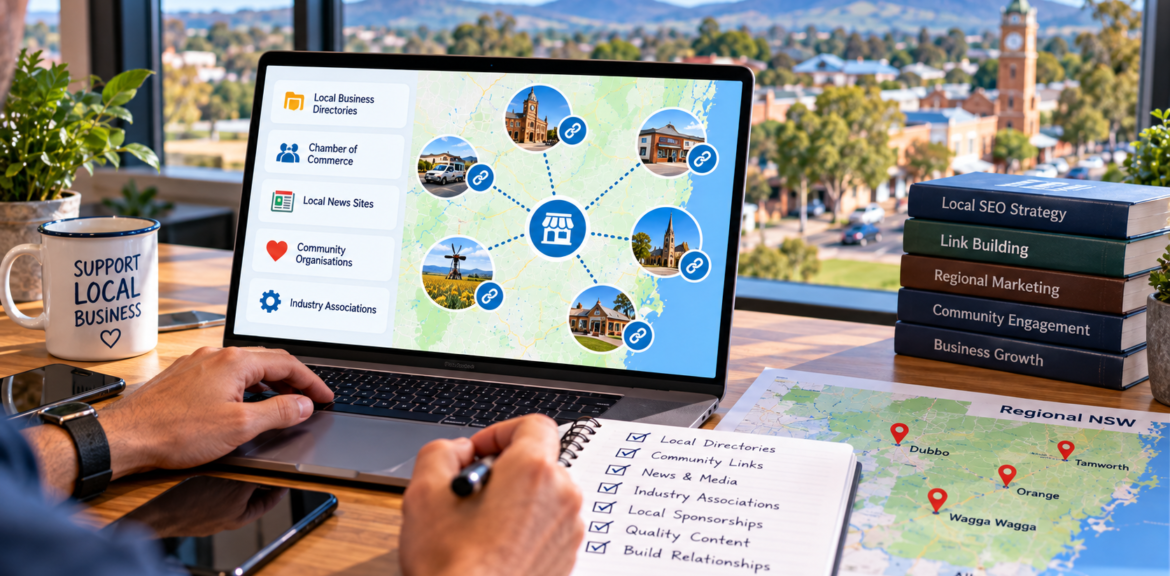

Most business owners get cold emails offering “50 high-authority backlinks for $99”. Most of them should go straight in the bin. Bad links can do more harm than good, and the good ones rarely come in a bulk package.
For a regional business, the better news is that real, valuable links are often sitting right in your community. A chamber of commerce directory, a footy club sponsorship page, a supplier’s “find a stockist” list, a local news story. These links are relevant, credible and almost impossible for a faceless link seller to replicate.
This guide shows how to find them.
What a backlink is, and why it still matters
A backlink is a link from another website to yours. Search engines have long treated links as a signal that other sites consider your content worth referencing. That idea hasn’t gone away. In fact, as AI-generated answers draw on sources that already look credible, off-site authority matters more, not less.
Industry surveys such as Whitespark’s Local Search Ranking Factors consistently list link signals as a meaningful factor for both local pack and local organic results. It’s an expert survey rather than a Google statement, so treat the weighting as guidance, but the principle is solid: relevant, trustworthy mentions help.
For regional businesses, the advantage is clear. Where competition is lighter, a handful of quality local links can make a visible difference.
What Google says about links
Google’s spam policies include link spam, which covers buying or selling links that pass ranking credit, excessive link exchanges, large-scale guest posting campaigns with keyword-rich anchor text, and automated link creation. Paid or sponsored links should use the appropriate attributes so they don’t pass ranking credit. You can read the policy at Google Search Central.
The takeaway: earn links because you’re genuinely worth linking to, not because you’ve engineered them.
Where regional businesses can earn good links
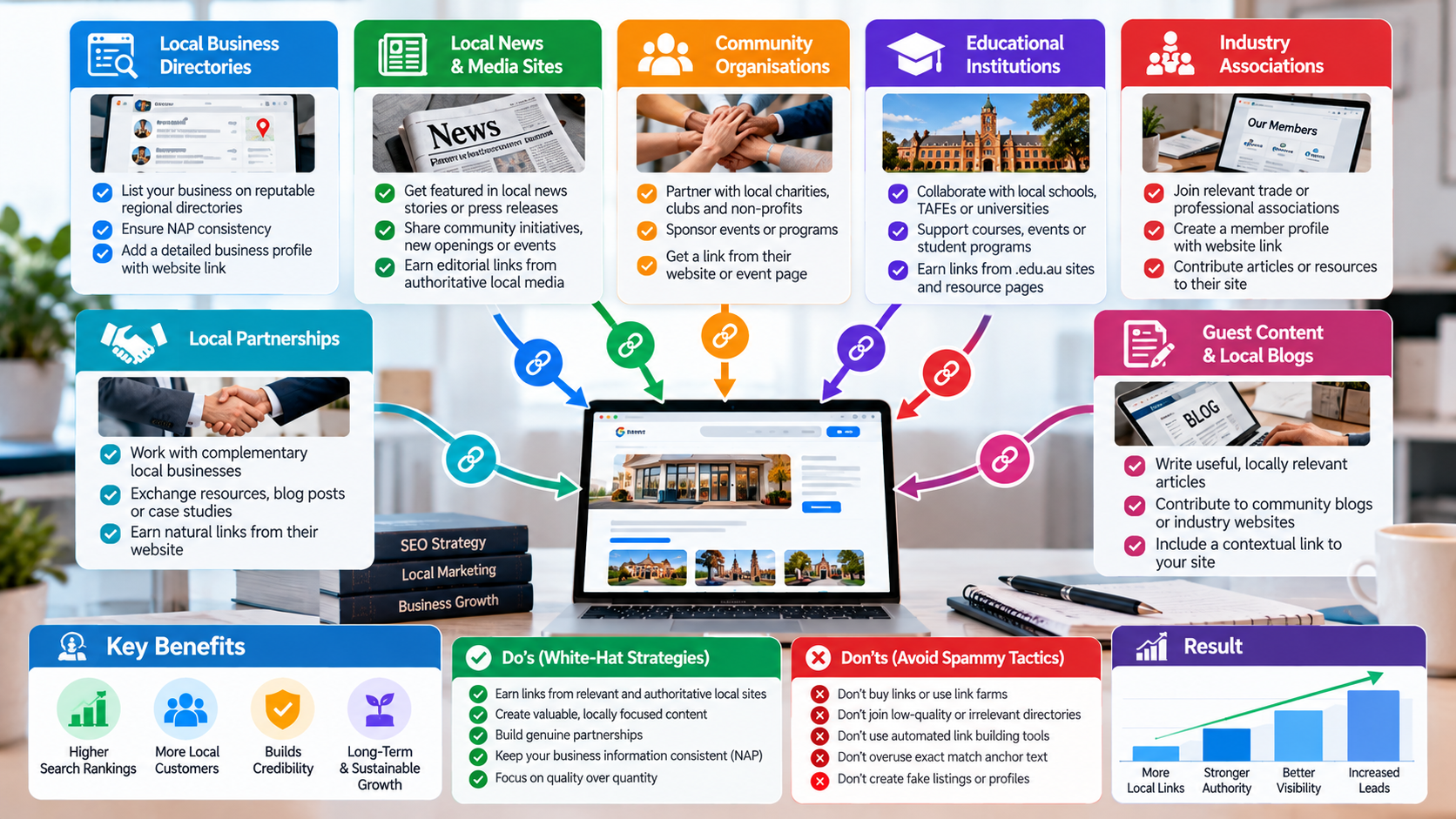
1. Local business organisations and chambers
Local chambers of commerce, business associations and industry bodies often list members on their websites. If you’re a member, make sure your listing links to your site and the details are accurate. Check whether your region has a business awards program, as winners and finalists often get a web mention.
2. Community sponsorships
Sponsoring a junior footy team, a local show, a school fete or a charity event often earns a mention on the organiser’s site. Ask where your logo and link will appear before you commit. Sponsor because it’s good for your community and brand, and treat the link as a bonus.
3. Suppliers, manufacturers and partners
If you install, stock or service branded products, check whether the supplier has a “find an installer” or “authorised dealer” page. A link from the manufacturer carries real weight because it’s relevant and genuine.
4. Industry associations and accreditations
Trade associations, professional bodies and accreditation schemes usually list members. These links also build trust with customers, which helps both rankings and conversions.
5. Local media and news
Regional newspapers, radio stations and community news sites are always hungry for local stories. Think about:
- A milestone, such as a tenth anniversary or new premises
- A genuinely useful local tip from your trade, such as how to prepare plumbing for a cold snap
- A community project you’ve contributed to
- A new apprentice intake or local hiring news
- Local data you’ve gathered from your own work
Send a short, relevant pitch to a named journalist or editor. Don’t expect every pitch to land, but one good regional story can produce links, referral traffic and brand awareness.
6. Local events and charity partnerships
If you host or take part in a workshop, open day, fundraiser or field day, event organisers and local council sites often publish partner lists and event pages.
7. Councils, tourism bodies and local directories
Some regional councils and tourism organisations run business directories or “shop local” pages. Check eligibility and apply where it’s relevant. Be selective with general directories, because quality matters far more than quantity.
8. Reclaim unlinked mentions
Sometimes people mention your business without linking to it, perhaps in a news story, a club newsletter or a supplier blog. Search for your business name occasionally and politely ask for a link where it makes sense.
9. Publish something worth linking to
People link to useful things: a locally relevant guide, original data, a free checklist, a clear explainer on a confusing local rule. Real expertise shared well tends to earn links over time. This is the same principle behind helpful content: if it’s useful to a real customer, it’s more likely to be cited.
What to avoid
- Buying links or paying for guest posts on sites that exist to sell links
- Private blog networks, which are groups of sites built to pass authority
- Mass directory submissions to hundreds of low-quality listings
- Exact-match anchor text overkill, such as repeated “best plumber Dubbo” links
- Link exchanges at scale
- Comment and forum spam
- Fake profiles or fake local “reviews” sites built to host links
These can trigger manual actions or algorithmic discounting, and recovering is slow and expensive.
How to build a sensible local link plan
- Audit what you’ve already got. Check your existing backlinks with Google Search Console or a reputable link tool, and clean up any obvious problems.
- Map your real relationships. List suppliers, associations, sponsorships, community groups and events you’re already involved in.
- Fix the easy ones first. Make sure existing listings link to the right page with correct details.
- Create something link-worthy. A solid local guide, case study or resource gives people something to reference.
- Pitch the local press a few times a year with something actually newsworthy.
- Track results. Look at referring domains, referral traffic and enquiries, not just link counts.
Tie it back to your pages
Links work best when they point to pages that deserve them. A link to a thin town page won’t achieve much, while a link to a strong service page or a genuinely helpful guide can. Make sure your pages are structured well first. Our guide to ranking in multiple NSW towns without doorway pages shows how, and our Google Business Profile checklist covers the local signals that sit alongside links.
Examples across regional NSW
The opportunities differ by region.
- In Armidale, a university and education community gives you opportunities with campus groups and local events.
- In Orange, the food, wine and tourism scene offers partnerships with producers and event organisers.
- In Dubbo, agricultural suppliers, transport businesses and regional events are good starting points.
- In Coffs Harbour and Port Macquarie, tourism bodies, community events and local clubs may offer opportunities.
- In Newcastle, Wollongong and the Central Coast, denser media and business networks give more options but also more competition for attention.
How we approach it
Link building is part of our broader search engine optimisation work, and we keep it ethical and white-hat. We focus on relevant, community-rooted opportunities rather than bulk packages. If you’re choosing a provider, our guide to choosing a digital marketing agency includes questions worth asking about link building, and our free SEO analysis can show where your link profile currently stands.